
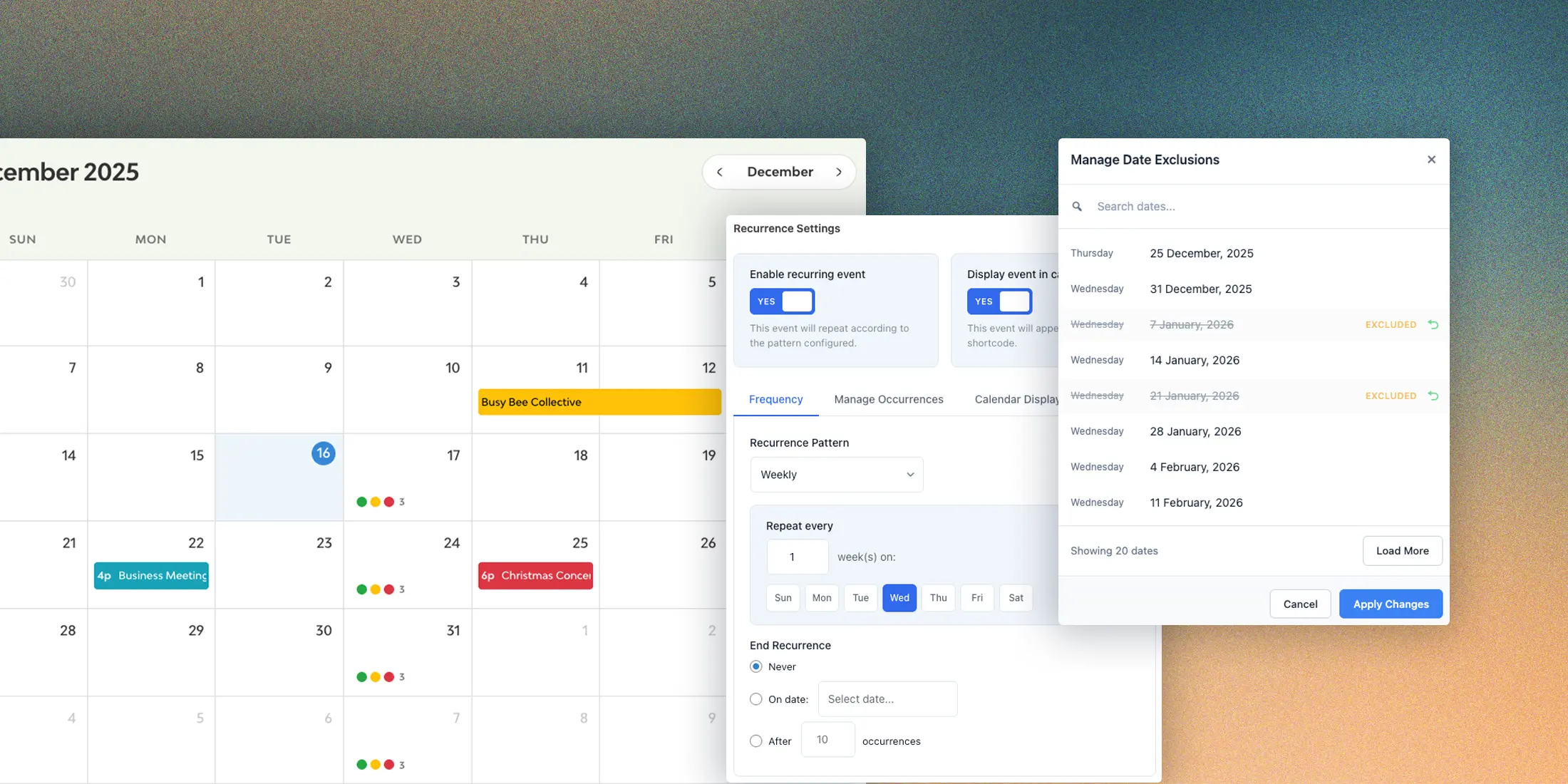

My boss has recently debuted a brand-new events plugin onto the WordPress scene. He asked me to favourably compare it to other similar plugins. I realise that this screams conflict of interest, or at least it would do if I were in a high enough wage bracket for biased loyalty or scared of losing my job for my candour. But neither is true in my case, so I have a lot of space to be brutally honest. Trust me bro!
The comparable events/calendar plugins at the top of the pile, such as Events Manager, Amelia, The Events Calendar, WP Event Manager, etc, are comprehensive and often complicated events programs. They handle the full load of scheduling, ticketing, payments, calendar displays, attendee tracking, analytics, registration and much more. Because of their broad range of functionality, these plugins can tend to be bloated and unwieldy, and often have problems with integration into different WordPress themes and page builders. Recent plugin arrival EventKoi looks great and promises flexibility, but like the others, suffers from resistance to customisation. Crucially, very few events plugins handle recurring events, or if they do, they only offer it in a subscription version.
Enter Lista Recurring Events (LRE). It was designed as a simple, lightweight solution for displaying recurring events on a website, without the annoyance of duplicated post entries and the bloat of a dozen other functionalities that you may never use on your website. What makes Recurring Events most unique is that it works with custom post types and custom fields (with multiple CPT support), so it does not require customisation to integrate it into page designs or themes. You have full design flexibility from the get-go, and the plugin seamlessly populates recurring events with the style and layout that you have already set in theme templates. It also adds those events to an attractive and responsive calendar display.
As of this writing, Lista Recurring Events plugin has deep integrations with Bricks Builder and the free version of Elementor, and recognises CPT plugins such as Advanced Custom Fields, JetEngine, Meta Box, and Advanced Custom Post Types. Integrations with other plugins and page builders are no doubt on the drawing board. There is also a growing list of optional add-ons in development for those who want additional functions (such as ticket sales and attendee management) that are as lightweight and flexible as the main plugin. The most recent update introduces a “native” mode in which you can set up Custom Post Types and Custom Fields within the LRE plugin itself, eliminating the need for a separate CPT plugin to create the necessary post types and fields. If you want to use your existing CPTs, you would choose “integration” mode at setup.
I am a front-end developer midway through training, so before I could experiment with the plugin and assess it, I had to spend some time getting my head around custom post types, custom fields, query loops, and dynamic tags. It was all rather challenging, and I fully expected the plugin to be equally tough to learn. But I was pleasantly surprised by its simplicity. Plugin installation and setup were dead easy, as was entering the necessary dynamic content onto pages. I struggled with some aspects of the plugin, but in the end, all of my issues were attributable to my inexperience with dynamic content and templates instead of the useability of LRE). Experienced developers would have absolutely no problem with it. A big plus is the availability of easy-to-read documentation, and short instructional videos that explain how to set LRE up and use it with the supported page builders.
My last mission was to test out the only plugin I could find that was similar enough to Lista Recurring Events to be a direct competitor. This plugin is Event Organiser (EO). Like LRE, it uses custom post types to configure events, and also like LRE, it has a flexible recurring event function, list views, and a calendar. It has a couple of minor functions that are not in LRE, such as widgets. Paid versions of the plugin have extras like venue management, bookings, and a payment gateway. All of the extras are available individually as either paid or free extensions, and are included in the highest subscription tier (paid in British pounds, which would be extra pricey anywhere that isn’t England).
Initially, Events Organiser is as easy to use as LRE. The biggest difference is that Events Organiser only allows you to use the CPTs and custom fields generated by the plugin. While LRE can create CPTs if you want it to, it can also use what you have already set up. But the biggest advantage that LRE has over EO is its intrinsic customisation abilities. To modify and integrate the very basic and frankly unattractive events list that the EO plugin produces, you need to be familiar with a certain amount of PHP coding and custom CSS. In contrast, LRE does not produce events listing displays, but simply generates recurrences of displays you have already designed. The original layout is inherited without any coding necessary. All that is required to use LRE is familiarity with dynamic content configuration in either of the supported the page builders, and a working knowledge of CPTs. Event recurrences basically come out automatically customised. LRE easily outshines EO and similar plugins with this inherent flexibility and effortless customisability. Instead of taking centre stage and tripping up other performers, LRE simply works quietly and efficiently backstage.
Lista Recurring Events certainly delivers what it promises, which is “smart, lightweight recurrence logic that works with your existing setup”. While LRE’s superior performance is impressive, one cannot write a post about LRE without mentioning the cost advantage. LRE pricing is modelled on a one-off cost instead of a yearly subscription. It easily outstrips the free version limitations of similar plugins, and runs circles around the often eye-watering cost of the subscription versions. If you are quick enough, you can even get it at the launch discount. Off you go now folks, buy my boss’s brilliant plugin!